Typing Rhythms Beyond the Latin Script: An Amharic–English Keystroke Dynamics Benchmark
DOI:
https://doi.org/10.35566/jbds0228Keywords:
Keystroke dynamics, Behavioral biometrics, Amharic keystroke, Continuous authentication, Ethiopic scriptAbstract
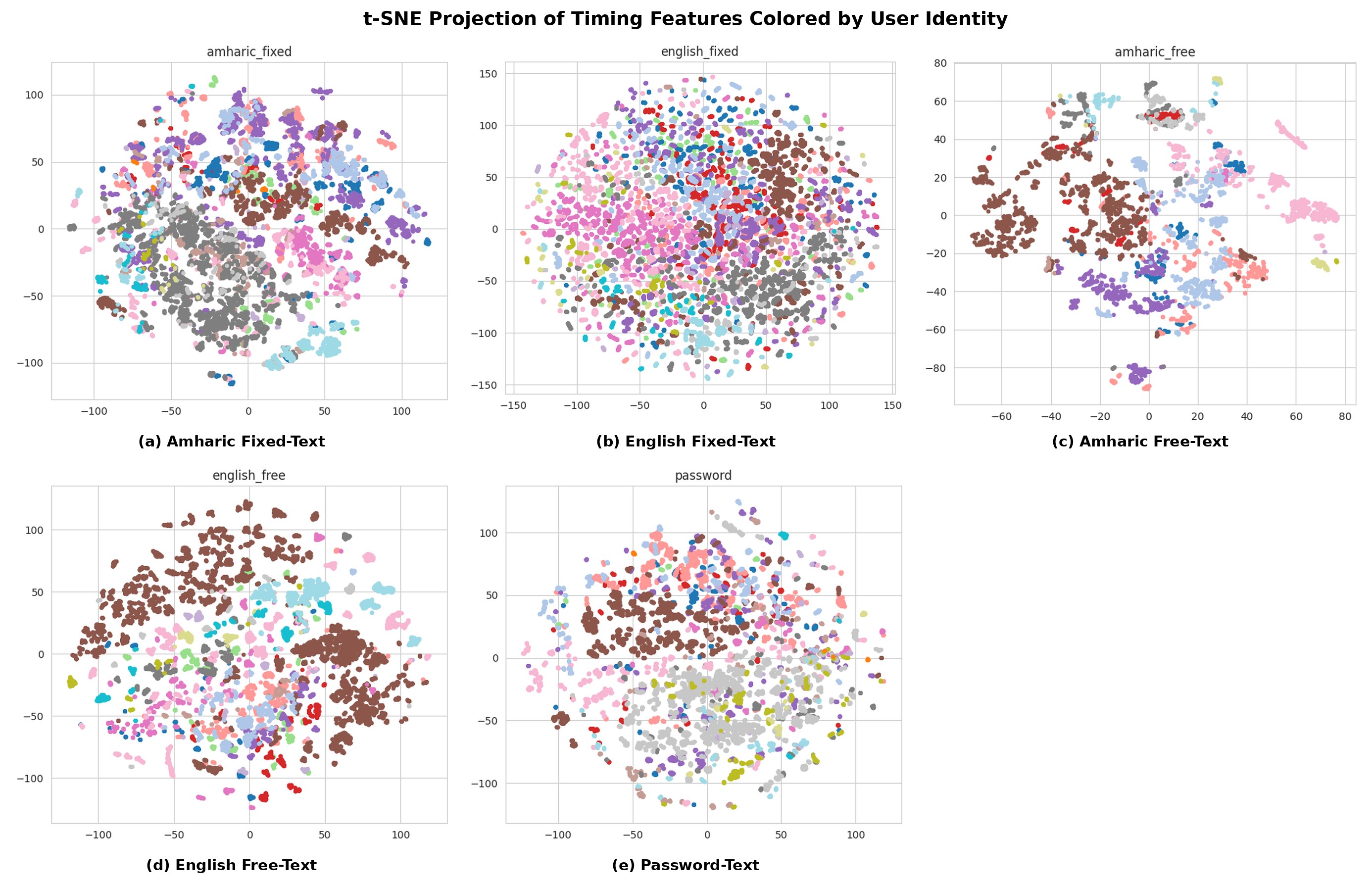
Keystroke dynamics---the timing of a person's key presses and releases---is a low-cost, non-intrusive behavioral biometric. However, public benchmarks and most empirical evidence focus on typing in Latin scripts, predominantly English, and do not cover speakers of Ge'ez-script (Ethiopic) languages such as Amharic, which has more than 35 million native speakers. Ethiopic syllabic characters are commonly entered through multi-key transliteration, creating different motor-planning demands. This raises the question of whether timing-based verification methods developed for Latin scripts transfer effectively to other writing systems. We present and characterize a keystroke dynamics corpus collected from a shared pool of typists completing three text-entry tasks---fixed text, free text, and password entry---in Amharic and English. The corpus contains 114,955 labeled keystroke events across five sub-corpora (4,751--51,813 rows each), with up to 25 raw and derived timing fields per event. We report a systematic exploratory data analysis (EDA) covering structural composition; missingness and duplication; demographic and skill-level coverage; univariate and bivariate timing distributions; feature redundancy (correlation and hierarchical clustering); per-user sample imbalance; and user distinguishability in Principal Component Analysis (PCA), t-Distributed Stochastic Neighbor Embedding (t-SNE), and Uniform Manifold Approximation and Projection (UMAP) projections. The analysis finds strongly right-skewed timing features, a small number of algebraically redundant feature pairs, a coefficient of variation in per-user sample counts of up to 2.4, and substantial visual overlap between users in low-dimensional projections. Together, these properties plausibly explain the 40--60% rank-1 accuracy and 10--20% equal error rate (EER) previously obtained with baseline classifiers on this cohort. Based on these diagnostics and recent literature, we recommend feature engineering, session- and user-aware evaluation protocols, and careful model selection for keystroke biometrics in low-resource, non-Latin-script settings. We also make the EDA pipeline available for benchmarking. To the best of our knowledge, this is the first analysis of tri-modal keystroke dynamics data in an Ethiopic-script language, providing a reference point for cross-lingual and cross-script research in behavioral biometrics.
References
Abuhamad, M., Abusnaina, A., Nyang, D., & Mohaisen, D. (2021). Sensor-based continuous authentication of smartphones’ users using behavioral biometrics: A contemporary survey. IEEE Internet of Things Journal, 8(1), 65–84. doi: https://doi.org/10.1109/JIOT.2020.3020076
Acien, A., Morales, A., Monaco, J. V., Vera-Rodriguez, R., & Fierrez, J. (2022). TypeNet: Deep learning keystroke biometrics. IEEE Transactions on Biometrics, Behavior, and Identity Science, 4(1), 57–70. doi: https://doi.org/10.1109/tbiom.2021.3112540
Ayotte, B., Banavar, M., Hou, D., & Schuckers, S. (2020). Fast free-text authentication via instance-based keystroke dynamics. IEEE Transactions on Biometrics, Behavior, and Identity Science, 2(4), 377–387. doi: https://doi.org/10.1109/tbiom.2020.3003988
Belay, B., Habtegebrial, T., Meshesha, M., Liwicki, M., Belay, G., & Stricker, D. (2020). Amharic OCR: An end-to-end learning. Applied Sciences, 10(3), 1117. doi: https://doi.org/10.3390/app10031117
Chari, T., & Pachter, L. (2023). The specious art of single-cell genomics. PLOS Computational Biology, 19(8), e1011288. doi: https://doi.org/10.1371/journal.pcbi.1011288
Delgado-Santos, P., Stragapede, G., Tolosana, R., Guest, R., Deravi, F., & Vera-Rodriguez, R. (2022). A survey of privacy vulnerabilities of mobile device sensors. ACM Computing Surveys, 54(11s), 1–30. doi: https://doi.org/10.1145/3510579
Dhakal, V., Feit, A. M., Kristensson, P. O., & Oulasvirta, A. (2018). Observations on typing from 136 million keystrokes. In Proceedings of the 2018 CHI conference on human factors in computing systems (pp. 1–12). ACM. doi: https://doi.org/10.1145/3173574.3174220
Dias, T., Vitorino, J., Maia, E., Sousa, O., & Praça, I. (2023). KeyRecs: A keystroke dynamics and typing pattern recognition dataset. Data in Brief , 50, 109509. doi: https://doi.org/10.1016/j.dib.2023.109509
Drozdowski, P., Rathgeb, C., Dantcheva, A., Damer, N., & Busch, C. (2020). Demographic bias in biometrics: A survey on an emerging challenge. IEEE Transactions on Technology and Society, 1(2), 89–103. doi: https://doi.org/10.1109/TTS.2020.2992344
Giot, R., El-Abed, M., & Rosenberger, C. (2009). GREYC keystroke: A benchmark for keystroke dynamics biometric systems. In 2009 IEEE 3rd international conference on biometrics: Theory, applications, and systems (pp. 1–6). IEEE. doi: https://doi.org/10.1109/btas.2009.5339051
González, N., Calot, E. P., Ierache, J. S., & Hasperué, W. (2022). Towards liveness detection in keystroke dynamics: Revealing synthetic forgeries. Systems and Soft Computing, 4, 200037. doi: https://doi.org/10.1016/j.sasc.2022.200037
González, N., Stragapede, G., Vera-Rodriguez, R., & Tolosana, R. (2025). Type2Branch: Keystroke biometrics based on a dual-branch architecture with attention mechanisms and set2set loss. IEEE Transactions on Information Forensics and Security, 20, 5859–5871. doi: https://doi.org/10.1109/TIFS.2025.3574992
Indiana University. (n.d.). Amharic [Language information portal]. https://celt.indiana.edu/portal/Amharic. (Retrieved October 28, 2026)
Kang, P. (2015). The effects of different alphabets on free text keystroke authentication: A case study on the Korean–English users. Journal of Systems and Software, 102, 1–11. doi: https://doi.org/10.1016/j.jss.2014.12.017
Kapoor, S., & Narayanan, A. (2023). Leakage and the reproducibility crisis in machine-learning-based science. Patterns, 4(9), 100804. doi: https://doi.org/10.1016/j.patter.2023.100804
Killourhy, K. S., & Maxion, R. A. (2009). Comparing anomaly-detection algorithms for keystroke dynamics. In 2009 IEEE/IFIP international conference on dependable systems & networks (pp. 125–134). IEEE. doi: https://doi.org/10.1109/dsn.2009.5270346
Kim, J., & Kang, P. (2020). Freely typed keystroke dynamics-based user authentication for mobile devices based on heterogeneous features. Pattern Recognition, 108, 107556. doi: https://doi.org/10.1016/j.patcog.2020.107556
Lis, K., Niewiadomska-Szynkiewicz, E., & Dziewulska, K. (2023). Siamese neural network for keystroke dynamics-based authentication on partial passwords. Sensors, 23(15), 6685. doi: https://doi.org/10.3390/s23156685
McInnes, L., Healy, J., Saul, N., & Großberger, L. (2018). Umap: Uniform manifold approximation and projection. Journal of Open Source Software, 3(29), 861. Retrieved from http://dx.doi.org/10.21105/joss.00861 doi: https://doi.org/10.21105/joss.00861
Microsoft. (n.d.). Amharic IME. Microsoft Learn. https://learn.microsoft.com/globalization/input/amharic-ime. (Retrieved October 28, 2026)
Shadman, R., Wahab, A. A., Manno, M., Lukaszewski, M., Hou, D., & Hussain, F. (2025). Keystroke dynamics: Concepts, techniques, and applications. ACM Computing Surveys, 57(11), 1–35. doi: https://doi.org/10.1145/3733103
Sitová, Z., Šeděnka, J., Yang, Q., Peng, G., Zhou, G., Gasti, P., & Balagani, K. S. (2016). HMOG: New behavioral biometric features for continuous authentication of smartphone users. IEEE Transactions on Information Forensics and Security, 11(5), 877–892. doi: https://doi.org/10.1109/tifs.2015.2506542
Stragapede, G., Delgado-Santos, P., Tolosana, R., Vera-Rodriguez, R., Guest, R., & Morales, A. (2023). Mobile keystroke biometrics using transformers. In 2023 IEEE 17th international conference on automatic face and gesture recognition (FG) (pp. 1–6). IEEE. doi: https://doi.org/10.1109/FG57933.2023.10042710
Stragapede, G., Delgado-Santos, P., Tolosana, R., Vera-Rodriguez, R., Guest, R., & Morales, A. (2024). TypeFormer: Transformers for mobile keystroke biometrics. Neural Computing and Applications, 36(29), 18531–18545. doi: https://doi.org/10.1007/s00521-024-10140-2
Stragapede, G., Vera-Rodriguez, R., Tolosana, R., & Morales, A. (2023). BehavePassDB: Public database for mobile behavioral biometrics and benchmark evaluation. Pattern Recognition, 134, 109089. doi: https://doi.org/10.1016/j.patcog.2022.109089
Stragapede, G., Vera-Rodriguez, R., Tolosana, R., Morales, A., Damer, N., Fierrez, J., & Ortega-Garcia, J. (2024). Keystroke verification challenge (KVC): Biometric and fairness benchmark evaluation. IEEE Access, 12, 1102–1116. doi: https://doi.org/10.1109/ACCESS.2023.3345452
Stragapede, G., Vera-Rodriguez, R., Tolosana, R., Morales, A., DeAndres-Tame, I., Damer, N., … others (2025). KVC-ongoing: Keystroke verification challenge. Pattern Recognition, 161, 111287. doi: https://doi.org/10.1016/j.patcog.2024.111287
Stragapede, G., Vera-Rodriguez, R., Tolosana, R., Morales, A., Fierrez, J., Ortega-Garcia, J., … others (2022). IJCB 2022 mobile behavioral biometrics competition (MobileB2C). In 2022 IEEE international joint conference on biometrics (IJCB) (pp. 1–7). IEEE. doi: https://doi.org/10.1109/IJCB54206.2022.10007985
Stylios, I., Kokolakis, S., Thanou, O., & Chatzis, S. (2021). Behavioral biometrics & continuous user authentication on mobile devices: A survey. Information Fusion, 66, 76–99. doi: https://doi.org/10.1016/j.inffus.2020.08.021
Sun, Y., Ceker, H., & Upadhyaya, S. (2016). Shared keystroke dataset for continuous authentication. In 2016 IEEE international workshop on information forensics and security (WIFS) (pp. 1–6). IEEE. doi: https://doi.org/10.1109/WIFS.2016.7823894
Tonja, A. L., Azime, I. A., Belay, T. D., Yigezu, M. G., Mehamed, M. A. A., Ayele, A. A., … Yimam, S. M. (2024). EthioLLM: Multilingual large language models for Ethiopian languages with task evaluation. In Proceedings of the 2024 joint international conference on computational linguistics, language resources and evaluation (LREC-COLING 2024) (pp. 6341–6352). ELRA and ICCL. doi: https://doi.org/10.63317/3xseji2kaeg2
Tsimperidis, I., Yucel, C., & Katos, V. (2021). Age and gender as cyber attribution features in keystroke dynamic-based user classification processes. Electronics, 10(7), 835. doi: https://doi.org/10.3390/electronics10070835
van der Maaten, L., & Hinton, G. (2008). Visualizing data using t-SNE. Journal of Machine Learning Research, 9(11).
Wahab, A. A., & Hou, D. (2023). When simple statistical algorithms outperform deep learning: A case of keystroke dynamics. In Proceedings of the 12th international conference on pattern recognition applications and methods (ICPRAM) (Vol. 1, pp. 363–370). SCITEPRESS. doi: https://doi.org/10.5220/0011684100003411
Wahab, A. A., Hou, D., Banavar, M., Schuckers, S., Eaton, K., Baldwin, J., & Wright, R. (2022). Shared multi-keyboard and bilingual datasets to support keystroke dynamics research. In Proceedings of the twelfth ACM conference on data and application security and privacy (pp. 236–241). ACM. doi: https://doi.org/10.1145/3508398.3511516
Wang, Y., Huang, H., Rudin, C., & Shaposhnik, Y. (2021). Understanding how dimension reduction tools work: An empirical approach to deciphering t-SNE, UMAP, TriMap, and PaCMAP for data visualization. Journal of Machine Learning Research, 22(201), 1–73.
Yimam, S. M., Ayele, A. A., Venkatesh, G., Gashaw, I., & Biemann, C. (2021). Introducing various semantic models for Amharic: Experimentation and evaluation with multiple tasks and datasets. Future Internet, 13(11), 275. doi: https://doi.org/10.3390/fi13110275